The Psychology of Technical Analysis Profiting From Crowd Behavior Review
In finance, technical analysis is an assay methodology for forecasting the direction of prices through the study of by marketplace data, primarily price and volume.[1] Behavioral economics and quantitative analysis employ many of the aforementioned tools of technical analysis,[ii] [three] [four] which, being an aspect of active management, stands in contradiction to much of modern portfolio theory. The efficacy of both technical and fundamental assay is disputed past the efficient-market hypothesis, which states that stock marketplace prices are essentially unpredictable,[five] and enquiry on whether technical analysis offers any benefit has produced mixed results.[half dozen] [seven] [8]
History [edit]
The principles of technical assay are derived from hundreds of years of financial market information.[nine] Some aspects of technical analysis began to appear in Amsterdam-based merchant Joseph de la Vega's accounts of the Dutch financial markets in the 17th century. In Asia, technical assay is said to be a method developed past Homma Munehisa during the early 18th century which evolved into the apply of candlestick techniques, and is today a technical analysis charting tool.[10] [xi]
Journalist Charles Dow (1851-1902) compiled and closely analyzed American stock marketplace data, and published some of his conclusions in editorials for The Wall Street Journal. He believed patterns and business concern cycles could maybe be found in this data, a concept later known as "Dow theory". All the same, Dow himself never advocated using his ideas as a stock trading strategy.
In the 1920s and 1930s, Richard W. Schabacker published several books which continued the piece of work of Charles Dow and William Peter Hamilton in their books Stock Marketplace Theory and Do and Technical Market Assay. In 1948, Robert D. Edwards and John Magee published Technical Analysis of Stock Trends which is widely considered to be one of the seminal works of the subject area. It is exclusively concerned with tendency assay and nautical chart patterns and remains in utilise to the present. Early on technical assay was nigh exclusively the assay of charts considering the processing power of computers was not available for the modernistic caste of statistical analysis. Charles Dow reportedly originated a form of point and figure nautical chart analysis. With the emergence of behavioral finance equally a split discipline in economics, Paul V. Azzopardi combined technical analysis with behavioral finance and coined the term "Behavioral Technical Analysis".[12]
Other pioneers of analysis techniques include Ralph Nelson Elliott, William Delbert Gann, and Richard Wyckoff who adult their respective techniques in the early on 20th century. More technical tools and theories have been developed and enhanced in recent decades, with an increasing emphasis on calculator-assisted techniques using specially designed estimator software.
General description [edit]
Fundamental analysts examine earnings, dividends, assets, quality, ratio, new products, enquiry and the like. Technicians employ many methods, tools and techniques also, one of which is the use of charts. Using charts, technical analysts seek to identify price patterns and marketplace trends in fiscal markets and effort to exploit those patterns.[13]
Technicians using charts search for archetypal price nautical chart patterns, such every bit the well-known caput and shoulders[fourteen] or double top/bottom reversal patterns, report technical indicators, moving averages and wait for forms such as lines of support, resistance, channels and more than obscure formations such equally flags, pennants, residuum days and cup and handle patterns.[15]
Technical analysts likewise widely use market indicators of many sorts, some of which are mathematical transformations of price, often including upwardly and down book, advance/decline data and other inputs. These indicators are used to aid assess whether an asset is trending, and if it is, the probability of its direction and of continuation. Technicians also look for relationships between toll/volume indices and market place indicators. Examples include the moving average, relative strength index and MACD. Other avenues of study include correlations between changes in Options (implied volatility) and put/call ratios with price. Also important are sentiment indicators such every bit Put/Telephone call ratios, bull/conduct ratios, short interest, Implied Volatility, etc.
There are many techniques in technical analysis. Adherents of different techniques (for example: Candlestick analysis, the oldest form of technical analysis developed past a Japanese grain trader; Harmonics; Dow theory; and Elliott wave theory) may ignore the other approaches, yet many traders combine elements from more than one technique. Some technical analysts use subjective judgment to decide which blueprint(s) a detail musical instrument reflects at a given time and what the estimation of that design should be. Others utilise a strictly mechanical or systematic approach to blueprint identification and estimation.
Comparison with fundamental analysis [edit]
Contrasting with technical analysis is key analysis: the study of economic & other underlying factors that influence the mode investors cost financial markets. This may include regular corporate metrics similar a companies recent EBITDA figures, the estimated impact of contempo staffing changes to the lath of directors, geopolitical considerations, and even scientific factors like the estimated future effects of global warming. Pure forms of technical assay can hold that prices already reflect all the underlying key factors. Uncovering future trends is what technical indicators are designed to practice, although neither technical nor fundamental indicators are perfect. Some traders utilise technical or fundamental analysis exclusively, while others use both types to brand trading decisions.[sixteen] [17]
Comparison with quantitative analysis [edit]
The contrast against quantitative analysis is less clear cut than the stardom with fundamental analysis. Some sources treat technical and quantitative analysis equally more or less synonymous. While others depict a sharp distinction. For example, quantitative analysis practiced Paul Wilmott suggests technical assay is little more 'charting' (making forecasts based on extrapolating graphical representations), and that technical assay rarely has any predictive power.[2] [17]
Characteristics [edit]
| | This section needs to be updated. (June 2021) |

Technical analysis employs models and trading rules based on toll and volume transformations, such as the relative strength alphabetize, moving averages, regressions, inter-market and intra-market price correlations, business cycles, stock market cycles or classically, through recognition of nautical chart patterns.
Technical analysis stands in contrast to the fundamental analysis approach to security and stock assay. In the fundamental equation "M = P/E" technical analysis is the test of Thousand (multiple). Multiple encompasses the psychology mostly abounding, i.due east. the extent of willingness to buy/sell. Also in Yard is the ability to pay as, for instance, a spent-out bull tin can't brand the marketplace go college and a well-heeled deport won't. Technical analysis analyzes price, book, psychology, money menstruation, and other market information, whereas fundamental analysis looks at the facts of the company, market place, currency, or article. Most large brokerages, trading groups, or financial institutions will typically have both a technical assay and central analysis team.
In the 1960s and 1970s, it was widely dismissed by academics. In a 2007 review, Irwin and Park[half-dozen] reported that 56 of 95 modern studies institute that information technology produces positive results but noted that many of the positive results were rendered dubious by issues such equally information snooping, so that the evidence in support of technical analysis was inconclusive; it is still considered by many academics to be indistinguishable from pseudoscience.[18] Academics such as Eugene Fama say the show for technical assay is thin and is inconsistent with the weak form of the efficient-market hypothesis.[19] [20] Users hold that even if technical analysis cannot predict the future, it helps to place trends, tendencies, and trading opportunities.[21]
While some isolated studies accept indicated that technical trading rules might lead to consequent returns in the period prior to 1987,[22] [7] [23] [24] most academic piece of work has focused on the nature of the dissonant position of the foreign exchange marketplace.[25] It is speculated that this anomaly is due to primal banking company intervention, which obviously technical assay is not designed to predict.[26]
Principles [edit]
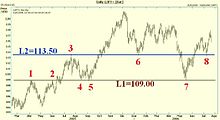
Stock chart showing levels of back up (4,5,6, 7, and 8) and resistance (ane, 2, and 3); levels of resistance tend to go levels of support and vice versa.[ citation needed ]
A cadre principle of technical assay is that a market'due south price reflects all relevant data impacting that market. A technical annotator therefore looks at the history of a security or commodity'due south trading pattern rather than external drivers such as economical, fundamental and news events. It is believed that price activity tends to echo itself due to the collective, patterned beliefs of investors. Hence technical analysis focuses on identifiable price trends and atmospheric condition.[27] [28]
Market action discounts everything [edit]
Based on the premise that all relevant information is already reflected by prices, technical analysts believe it is important to understand what investors think of that information, known and perceived.
Prices movement in trends [edit]
Technical analysts believe that prices trend directionally, i.e., up, down, or sideways (flat) or some combination. The bones definition of a toll tendency was originally put forward by Dow theory.[13]
An case of a security that had an apparent trend is AOL from Nov 2001 through August 2002. A technical analyst or trend follower recognizing this trend would look for opportunities to sell this security. AOL consistently moves downward in toll. Each fourth dimension the stock rose, sellers would enter the market and sell the stock; hence the "zig-zag" movement in the price. The series of "lower highs" and "lower lows" is a tell tale sign of a stock in a down trend.[29] In other words, each time the stock moved lower, it fell below its previous relative depression price. Each fourth dimension the stock moved higher, it could not reach the level of its previous relative high price.
Annotation that the sequence of lower lows and lower highs did not begin until August. Then AOL makes a low price that does not pierce the relative low set before in the calendar month. Later in the same month, the stock makes a relative high equal to the almost recent relative high. In this a technician sees strong indications that the down tendency is at least pausing and mayhap catastrophe, and would likely stop actively selling the stock at that point.
History tends to repeat itself [edit]
Technical analysts believe that investors collectively echo the behavior of the investors that preceded them. To a technician, the emotions in the market may be irrational, but they exist. Because investor behavior repeats itself and then often, technicians believe that recognizable (and predictable) price patterns will develop on a nautical chart.[xiii] Recognition of these patterns can permit the technician to select trades that accept a higher probability of success.[30]
Technical assay is not express to charting, just it always considers price trends.[1] For example, many technicians monitor surveys of investor sentiment. These surveys gauge the mental attitude of market participants, specifically whether they are bearish or bullish. Technicians utilize these surveys to help determine whether a trend volition continue or if a reversal could develop; they are near likely to conceptualize a change when the surveys written report extreme investor sentiment.[31] Surveys that evidence overwhelming bullishness, for instance, are bear witness that an uptrend may reverse; the premise being that if near investors are bullish they have already bought the market (anticipating higher prices). And because nigh investors are bullish and invested, one assumes that few buyers remain. This leaves more potential sellers than buyers, despite the bullish sentiment. This suggests that prices will trend downwardly, and is an example of contrarian trading.[32]
Industry [edit]
The industry is globally represented past the International Federation of Technical Analysts (IFTA), which is a federation of regional and national organizations. In the Us, the manufacture is represented by both the CMT Association and the American Association of Professional Technical Analysts (AAPTA). The United States is too represented by the Technical Security Analysts Clan of San Francisco (TSAASF). In the United Kingdom, the industry is represented by the Society of Technical Analysts (STA). The STA was a founding member of IFTA, has recently celebrated its 50th Anniversary and certifies analysts with the Diploma in Technical Assay. In Canada the industry is represented by the Canadian Society of Technical Analysts.[33] In Australia, the industry is represented by the Australian Technical Analysts Clan (ATAA),[34] (which is affiliated to IFTA) and the Australian Professional Technical Analysts (APTA) Inc.[35]
Professional technical analysis societies have worked on creating a body of cognition that describes the field of Technical Analysis. A body of knowledge is key to the field as a way of defining how and why technical analysis may work. It can then be used past academia, too every bit regulatory bodies, in developing proper research and standards for the field. The CMT Association has published a body of knowledge, which is the construction for the Chartered Market Technician (CMT) exam.[36] [37]
Software [edit]
Technical analysis software automates the charting, analysis and reporting functions that support technical analysts in their review and prediction of financial markets (e.g. the stock market).[ citation needed ]
In addition to installable desktop-based software packages in the traditional sense, the manufacture has seen an emergence of cloud-based applications and awarding programming interfaces (APIs) that deliver technical indicators (e.g., MACD, Bollinger Bands) via RESTful HTTP or intranet protocols.
Modern technical analysis software is often available equally a spider web or a smartphone application, without the need to download and install a software package.
Systematic trading [edit]
Neural networks [edit]
Since the early 1990s when the beginning practically usable types emerged, bogus neural networks (ANNs) have chop-chop grown in popularity. They are artificial intelligence adaptive software systems that have been inspired by how biological neural networks work. They are used considering they tin learn to detect complex patterns in information. In mathematical terms, they are universal office approximators,[38] [39] meaning that given the right information and configured correctly, they can capture and model any input-output relationships. This non only removes the need for human being interpretation of charts or the series of rules for generating entry/get out signals, merely also provides a bridge to fundamental analysis, every bit the variables used in key assay can be used every bit input.
As ANNs are substantially non-linear statistical models, their accurateness and prediction capabilities tin exist both mathematically and empirically tested. In diverse studies, authors have claimed that neural networks used for generating trading signals given various technical and central inputs have significantly outperformed buy-concur strategies too as traditional linear technical analysis methods when combined with dominion-based skillful systems.[forty] [41] [42]
While the advanced mathematical nature of such adaptive systems has kept neural networks for financial analysis generally within academic research circles, in recent years more user friendly neural network software has made the applied science more accessible to traders. [43]
Backtesting [edit]
Systematic trading is well-nigh frequently employed after testing an investment strategy on historic data. This is known as backtesting. Backtesting is most often performed for technical indicators, but can exist applied to almost investment strategies (e.g. central assay). While traditional backtesting was done past hand, this was usually only performed on human being-selected stocks, and was thus decumbent to prior knowledge in stock selection. With the advent of computers, backtesting can exist performed on entire exchanges over decades of historic data in very short amounts of time.
The apply of computers does accept its drawbacks, existence limited to algorithms that a estimator can perform. Several trading strategies rely on human interpretation,[44] and are unsuitable for reckoner processing.[45] Merely technical indicators which are entirely algorithmic can be programmed for computerized automated backtesting.
Combination with other market forecast methods [edit]
John Potato states that the principal sources of information available to technicians are price, book and open interest.[thirteen] Other information, such every bit indicators and sentiment analysis, are considered secondary.
However, many technical analysts attain outside pure technical assay, combining other market forecast methods with their technical work. One advocate for this approach is John Bollinger, who coined the term rational analysis in the middle 1980s for the intersection of technical assay and key analysis.[46] Some other such approach, fusion analysis, overlays fundamental analysis with technical, in an attempt to improve portfolio manager performance.
Technical analysis is too ofttimes combined with quantitative analysis and economics. For instance, neural networks may be used to help place intermarket relationships.[47]
Investor and newsletter polls, and mag embrace sentiment indicators, are also used by technical analysts.[48]
Empirical evidence [edit]
Whether technical analysis actually works is a matter of controversy. Methods vary greatly, and different technical analysts tin can sometimes make contradictory predictions from the same information. Many investors claim that they experience positive returns, but bookish appraisals oft find that it has footling predictive power.[49] Of 95 mod studies, 56 concluded that technical analysis had positive results, although data-snooping bias and other bug make the analysis difficult.[six] Nonlinear prediction using neural networks occasionally produces statistically meaning prediction results.[50] A Federal Reserve working paper[7] regarding support and resistance levels in short-term foreign commutation rates "offers strong evidence that the levels help to predict intraday tendency interruptions", although the "predictive power" of those levels was "found to vary across the exchange rates and firms examined".
Technical trading strategies were constitute to be constructive in the Chinese marketplace by a contempo study that states, "Finally, we discover significant positive returns on purchase trades generated by the contrarian version of the moving-average crossover dominion, the channel breakout dominion, and the Bollinger band trading rule, after accounting for transaction costs of 0.50%."[51]
An influential 1992 study by Brock et al. which appeared to notice back up for technical trading rules was tested for data snooping and other bug in 1999;[52] the sample covered by Brock et al. was robust to data snooping.
Afterwards, a comprehensive study of the question by Amsterdam economist Gerwin Griffioen concludes that: "for the U.Southward., Japanese and most Western European stock market indices the recursive out-of-sample forecasting procedure does not evidence to be profitable, afterwards implementing footling transaction costs. Moreover, for sufficiently high transaction costs it is found, by estimating CAPMs, that technical trading shows no statistically significant risk-corrected out-of-sample forecasting power for almost all of the stock market indices."[20] Transaction costs are particularly applicable to "momentum strategies"; a comprehensive 1996 review of the data and studies concluded that even small transaction costs would lead to an inability to capture any excess from such strategies.[53]
In a paper published in the Journal of Finance, Dr. Andrew W. Lo, director MIT Laboratory for Financial Engineering science, working with Harry Mamaysky and Jiang Wang plant that:
Technical analysis, also known every bit "charting", has been a part of financial practice for many decades, just this bailiwick has not received the aforementioned level of academic scrutiny and acceptance equally more than traditional approaches such equally fundamental analysis. Ane of the primary obstacles is the highly subjective nature of technical analysis – the presence of geometric shapes in historical cost charts is frequently in the eyes of the beholder. In this newspaper, we propose a systematic and automatic arroyo to technical design recognition using nonparametric kernel regression, and utilize this method to a large number of U.S. stocks from 1962 to 1996 to evaluate the effectiveness of technical analysis. By comparing the unconditional empirical distribution of daily stock returns to the conditional distribution – conditioned on specific technical indicators such as head-and-shoulders or double-bottoms – we find that over the 31-year sample menstruum, several technical indicators do provide incremental data and may take some applied value.[8]
In that same paper Dr. Lo wrote that "several academic studies propose that ... technical assay may well be an effective means for extracting useful information from market place prices."[8] Some techniques such as Drummond Geometry attempt to overcome the past information bias by projecting back up and resistance levels from differing time frames into the near-term future and combining that with reversion to the mean techniques.[54]
Efficient-market hypothesis [edit]
The efficient-market hypothesis (EMH) contradicts the basic tenets of technical assay by stating that past prices cannot be used to profitably predict hereafter prices. Thus it holds that technical analysis cannot exist effective. Economist Eugene Fama published the seminal paper on the EMH in the Journal of Finance in 1970, and said "In short, the evidence in support of the efficient markets model is extensive, and (somewhat uniquely in economics) contradictory prove is thin."[55]
All the same, because futurity stock prices can be strongly influenced by investor expectations, technicians claim it only follows that past prices influence future prices.[56] They also signal to research in the field of behavioral finance, specifically that people are not the rational participants EMH makes them out to be. Technicians accept long said that irrational human behavior influences stock prices, and that this behavior leads to anticipated outcomes.[57] Writer David Aronson says that the theory of behavioral finance blends with the practice of technical analysis:
By considering the bear upon of emotions, cognitive errors, irrational preferences, and the dynamics of group behavior, behavioral finance offers succinct explanations of excess market volatility as well as the excess returns earned by stale information strategies.... cognitive errors may also explicate the existence of market inefficiencies that spawn the systematic price movements that allow objective TA [technical analysis] methods to work.[56]
EMH advocates reply that while private market participants exercise not e'er act rationally (or take complete data), their aggregate decisions balance each other, resulting in a rational issue (optimists who buy stock and bid the price higher are countered by pessimists who sell their stock, which keeps the price in equilibrium).[58] Also, complete data is reflected in the cost considering all market place participants bring their own individual, but incomplete, knowledge together in the market place.[58]
Random walk hypothesis [edit]
The random walk hypothesis may be derived from the weak-course efficient markets hypothesis, which is based on the assumption that market participants take total account of any data contained in past price movements (but not necessarily other public data). In his book A Random Walk Down Wall Street, Princeton economist Burton Malkiel said that technical forecasting tools such every bit pattern assay must ultimately be self-defeating: "The problem is that once such a regularity is known to market participants, people will act in such a way that prevents it from happening in the time to come."[59] Malkiel has stated that while momentum may explain some stock price movements, at that place is non enough momentum to make backlog profits. Malkiel has compared technical assay to "astrology".[60]
In the late 1980s, professors Andrew Lo and Craig McKinlay published a newspaper which cast uncertainty on the random walk hypothesis. In a 1999 response to Malkiel, Lo and McKinlay collected empirical papers that questioned the hypothesis' applicability[61] that suggested a non-random and possibly predictive component to stock toll movement, though they were careful to point out that rejecting random walk does non necessarily invalidate EMH, which is an entirely split concept from RWH. In a 2000 paper, Andrew Lo back-analyzed data from the U.Due south. from 1962 to 1996 and found that "several technical indicators do provide incremental information and may have some practical value".[8] Burton Malkiel dismissed the irregularities mentioned by Lo and McKinlay as beingness too pocket-size to profit from.[lx]
Technicians say[ who? ] that the EMH and random walk theories both ignore the realities of markets, in that participants are not completely rational and that current cost moves are not independent of previous moves.[29] [62] Some indicate processing researchers negate the random walk hypothesis that stock marketplace prices resemble Wiener processes, because the statistical moments of such processes and real stock data vary significantly with respect to window size and similarity measure.[63] They argue that feature transformations used for the description of audio and biosignals tin can as well exist used to predict stock market prices successfully which would contradict the random walk hypothesis.
The random walk index (RWI) is a technical indicator that attempts to determine if a stock's price movement is random in nature or a consequence of a statistically significant tendency. The random walk index attempts to make up one's mind when the market place is in a strong uptrend or downtrend past measuring price ranges over N and how information technology differs from what would be expected past a random walk (randomly going up or down). The greater the range suggests a stronger tendency.[64]
Applying Kahneman and Tversky's prospect theory to cost movements, Paul 5. Azzopardi provided a possible explanation why fear makes prices autumn sharply while greed pushes up prices gradually.[65] This usually observed behaviour of securities prices is sharply at odds with random walk. By gauging greed and fear in the market,[66] investors tin better formulate long and short portfolio stances.
Scientific technical analysis [edit]
Caginalp and Balenovich in 1994[67] used their nugget-flow differential equations model to show that the major patterns of technical analysis could be generated with some basic assumptions. Some of the patterns such as a triangle continuation or reversal pattern can exist generated with the assumption of two distinct groups of investors with different assessments of valuation. The major assumptions of the models are that the finiteness of assets and the use of trend besides equally valuation in decision making. Many of the patterns follow as mathematically logical consequences of these assumptions.
I of the problems with conventional technical analysis has been the difficulty of specifying the patterns in a way that permits objective testing.
Japanese candlestick patterns involve patterns of a few days that are within an uptrend or downtrend. Caginalp and Laurent[68] were the offset to perform a successful big calibration exam of patterns. A mathematically precise set of criteria were tested by first using a definition of a brusque-term trend by smoothing the data and allowing for one deviation in the smoothed trend. They and so considered eight major three-twenty-four hours candlestick reversal patterns in a not-parametric manner and divers the patterns as a set of inequalities. The results were positive with an overwhelming statistical confidence for each of the patterns using the data set of all S&P 500 stocks daily for the five-year menstruation 1992–1996.
Amidst the virtually basic ideas of conventional technical analysis is that a trend, once established, tends to continue. However, testing for this trend has often led researchers to conclude that stocks are a random walk. One study, performed past Poterba and Summers,[69] found a small trend event that was likewise minor to be of trading value. As Fisher Blackness noted,[lxx] "noise" in trading price data makes it difficult to test hypotheses.
One method for avoiding this noise was discovered in 1995 past Caginalp and Constantine[71] who used a ratio of two essentially identical closed-stop funds to eliminate any changes in valuation. A closed-cease fund (unlike an open-end fund) trades independently of its net asset value and its shares cannot be redeemed, but merely traded amid investors every bit whatever other stock on the exchanges. In this study, the authors constitute that the best estimate of tomorrow's price is not yesterday's price (as the efficient-market place hypothesis would signal), nor is it the pure momentum cost (namely, the same relative price modify from yesterday to today continues from today to tomorrow). But rather it is almost exactly halfway between the 2.
Starting from the label of the past fourth dimension evolution of market prices in terms of price velocity and price dispatch, an attempt towards a full general framework for technical analysis has been adult, with the goal of establishing a principled classification of the possible patterns characterizing the departure or defects from the random walk market state and its time translational invariant properties.[72] The classification relies on two dimensionless parameters, the Froude number characterizing the relative strength of the acceleration with respect to the velocity and the time horizon forecast dimensionalized to the training period. Trend-following and contrarian patterns are found to coexist and depend on the dimensionless time horizon. Using a renormalisation group arroyo, the probabilistic based scenario approach exhibits statistically significant predictive power in substantially all tested market phases.
A survey of modernistic studies by Park and Irwin[73] showed that most establish a positive result from technical assay.
In 2011, Caginalp and DeSantis[74] take used big information sets of closed-finish funds, where comparing with valuation is possible, in guild to determine quantitatively whether key aspects of technical analysis such as trend and resistance have scientific validity. Using data sets of over 100,000 points they demonstrate that trend has an effect that is at to the lowest degree half every bit important equally valuation. The effects of volume and volatility, which are smaller, are also axiomatic and statistically significant. An important aspect of their work involves the nonlinear effect of trend. Positive trends that occur inside approximately 3.7 standard deviations have a positive effect. For stronger uptrends, there is a negative effect on returns, suggesting that profit taking occurs as the magnitude of the uptrend increases. For downtrends the situation is similar except that the "buying on dips" does non accept place until the downtrend is a four.6 standard deviation result. These methods tin can be used to examine investor beliefs and compare the underlying strategies amongst unlike nugget classes.
In 2013, Kim Homo Lui and T Chong pointed out that the past findings on technical assay generally reported the profitability of specific trading rules for a given set of historical information. These past studies had not taken the human trader into consideration as no existent-globe trader would mechanically adopt signals from any technical assay method. Therefore, to unveil the truth of technical analysis, we should become back to empathise the functioning between experienced and novice traders. If the marketplace actually walks randomly, there volition be no difference between these ii kinds of traders. Nonetheless, it is constitute by experiment that traders who are more than knowledgeable on technical analysis significantly outperform those who are less knowledgeable.[75]
Ticker-record reading [edit]
Until the mid-1960s, tape reading was a popular form of technical analysis. It consisted of reading market information such as price, volume, order size, and and then on from a paper strip which ran through a machine called a stock ticker. Marketplace data was sent to brokerage houses and to the homes and offices of the about active speculators. This system roughshod into disuse with the advent of electronic information panels in the late 60's, and later computers, which let for the easy preparation of charts.
Jesse Livermore, 1 of the most successful stock market place operators of all fourth dimension, was primarily concerned with ticker tape reading since a young historic period. He followed his own (mechanical) trading system (he called it the 'market place primal'), which did not demand charts, but was relying solely on toll data. He described his market key in particular in his 1940s book 'How to Trade in Stocks'.[76] Livermore's system was determining marketplace phases (trend, correction etc.) via by toll data. He also made use of book data (which he estimated from how stocks behaved and via 'market place testing', a procedure of testing market liquidity via sending in small market orders), as described in his 1940s volume.
Quotation board [edit]
Another form of technical analysis used then far was via interpretation of stock market data contained in quotation boards, that in the times before electronic screens, were huge chalkboards located in the stock exchanges, with data of the main fiscal assets listed on exchanges for analysis of their movements.[77] It was manually updated with chalk, with the updates regarding some of these data beingness transmitted to environments outside of exchanges (such as brokerage houses, bucket shops, etc.) via the same tape, telegraph, telephone and later on telex.[78]
This analysis tool was used both, on the spot, mainly by marketplace professionals, also as by general public through the printed versions in newspapers showing the data of the negotiations of the previous mean solar day, for swing and position trades.[79]
Charting terms and indicators [edit]
Concepts [edit]
- Average true range – averaged daily trading range, adjusted for price gaps.
- Breakout – the concept whereby prices forcefully penetrate an area of prior support or resistance, usually, just not e'er, accompanied past an increment in volume.
- Chart pattern – distinctive pattern created by the movement of security or article prices on a chart
- Cycles – time targets for potential change in cost activity (toll only moves up, down, or sideways)
- Dead cat bounciness – the phenomenon whereby a spectacular decline in the price of a stock is immediately followed by a moderate and temporary rise before resuming its downward move
- Elliott wave principle and the golden ratio to calculate successive toll movements and retracements
- Fibonacci ratios – used as a guide to determine support and resistance
- Momentum – the rate of price alter
- Point and figure analysis – A priced-based analytical arroyo employing numerical filters which may comprise time references, though ignores time entirely in its construction
- Resistance – a toll level that may prompt a internet increase of selling activity
- Support – a toll level that may prompt a net increase of buying activity
- Trending – the phenomenon by which cost move tends to persist in one direction for an extended period of fourth dimension
Types of charts [edit]
- Candlestick nautical chart – Of Japanese origin and similar to OHLC, candlesticks widen and fill the interval between the open and shut prices to emphasize the open/close relationship. In the West, frequently blackness or red candle bodies correspond a close lower than the open, while white, green or blue candles represent a close higher than the open cost.
- Line chart – Connects the closing price values with line segments. You tin can also choose to draw the line nautical chart using open, high or depression toll.
- Open-high-depression-close nautical chart – OHLC charts, besides known as bar charts, plot the span between the loftier and low prices of a trading period equally a vertical line segment at the trading time, and the open and close prices with horizontal tick marks on the range line, usually a tick to the left for the open up price and a tick to the correct for the endmost price.
- Betoken and effigy nautical chart – a nautical chart type employing numerical filters with just passing references to fourth dimension, and which ignores time entirely in its construction.
Overlays [edit]
Overlays are more often than not superimposed over the main price chart.
- Bollinger bands – a range of price volatility
- Channel – a pair of parallel trend lines
- Ichimoku kinko hyo – a moving average-based organization that factors in fourth dimension and the average point between a candle'due south high and low
- Moving average – an average over a window of fourth dimension before and later on a given fourth dimension bespeak that is repeated at each fourth dimension signal in the given chart. A moving boilerplate can be thought of as a kind of dynamic trend-line.
- Parabolic SAR – Wilder'south trailing cease based on prices disposed to stay within a parabolic curve during a strong tendency
- Pivot bespeak – derived past calculating the numerical average of a particular currency's or stock's loftier, low and closing prices
- Resistance – a price level that may act equally a ceiling above cost
- Support – a price level that may act every bit a floor beneath price
- Trend line – a sloping line described past at to the lowest degree two peaks or two troughs
- Zig Zag – This chart overlay that shows filtered price movements that are greater than a given percentage.
Latitude indicators [edit]
These indicators are based on statistics derived from the broad market.
- Advance–decline line – a popular indicator of market latitude.
- McClellan Oscillator – a popular closed-course indicator of breadth.
- McClellan Summation Index – a popular open up-form indicator of breadth.
Toll-based indicators [edit]
These indicators are by and large shown below or in a higher place the main price chart.
- Boilerplate directional index – a widely used indicator of trend strength.
- Commodity channel index – identifies cyclical trends.
- MACD – moving average convergence/difference.
- Momentum – the charge per unit of cost modify.
- Relative strength index (RSI) – oscillator showing cost force.
- Relative Vigor Index (RVI) – oscillator measures the confidence of a recent toll activeness and the likelihood that it volition continue.
- Stochastic oscillator – close position within recent trading range.
- Trix – an oscillator showing the slope of a triple-smoothed exponential moving average.
- Vortex Indicator – an indicator used to identify the being, continuation, initiation or termination of trends.
Volume-based indicators [edit]
- Accumulation/distribution index – based on the shut within the day'southward range.
- Money flow alphabetize – the amount of stock traded on days the price went up.
- On-balance volume – the momentum of buying and selling stocks.
Trading with Mixing Indicators [edit]
- MACD & Average directional alphabetize
- MACD & Super Trend
- MACD & Moving average
- MACD & RSI
- MACD & Moving Averages
See too [edit]
- Algorithmic trading
- Apophenia
- Behavioral finance
- Certified Financial Technician / Primary of Financial Technical Analysis
- Chartered Market Technician
- Clustering illusion
- Financial signal processing
- Market assay
- Market timing
- Mathematical finance
- Multimedia data retrieval
- Multiple comparisons problem
- Overfitting
- Price activity trading
- Texas sharpshooter fallacy
References [edit]
- ^ a b Kirkpatrick & Dahlquist (2006), p. 3
- ^ a b Akston, Dr. Hugh (13 Jan 2009). "Chirapsia the Quants at Their Own Game".
- ^ Mizrach, Bruce; Weerts, Susan (27 November 2007). "Highs and Lows: A Behavioral and Technical Analysis". SSRN 1118080.
- ^ Paul V. Azzopardi (2010). Behavioural Technical Analysis: An introduction to behavioural finance and its part in technical assay. Harriman Firm. ISBN978-1905641413.
- ^ Andrew Westward. Lo; Jasmina Hasanhodzic (2010). The Evolution of Technical Assay: Financial Prediction from Babylonian Tablets to Bloomberg Terminals. Bloomberg Press. p. 150. ISBN978-1576603499 . Retrieved 8 August 2011.
- ^ a b c Irwin, Scott H.; Park, Cheol-Ho (2007). "What Exercise We Know About the Profitability of Technical Analysis?". Periodical of Economic Surveys. 21 (4): 786–826. doi:ten.1111/j.1467-6419.2007.00519.10. S2CID 154488391.
- ^ a b c Osler, Karen (July 2000). "Support for Resistance: Technical Analysis and Intraday Commutation Rates," FRBNY Economic Policy Review (abstract and paper hither).
- ^ a b c d Lo, Andrew W.; Mamaysky, Harry; Wang, Jiang (2000). "Foundations of Technical Analysis: Computational Algorithms, Statistical Inference, and Empirical Implementation". Journal of Finance. 55 (four): 1705–1765. CiteSeerXx.1.1.134.1546. doi:10.1111/0022-1082.00265.
- ^ Joseph de la Vega, Confusión de Confusiones, 1688
- ^ Nison, Steve (1991). Japanese Candlestick Charting Techniques. pp. 15–18. ISBN978-0-13-931650-0.
- ^ Nison, Steve (1994). Beyond Candlesticks: New Japanese Charting Techniques Revealed, John Wiley and Sons, p. 14. ISBN 0-471-00720-10
- ^ Paul V. Azzopardi, "Behavioral Technical Analysis", ibid
- ^ a b c d Murphy, John J. Technical Analysis of the Financial Markets. New York Establish of Finance, 1999, pp. ane–five, 24–31. ISBN 0-7352-0066-1
- ^ "PrimePair.com Caput and Shoulders Blueprint". Archived from the original on half dozen Jan 2015. Retrieved 6 January 2015.
- ^ Elderberry (1993), Office III: Classical Chart Assay
- ^ Elder (1993), Part II: "Mass Psychology"; Chapter 17: "Managing versus Forecasting", pp. 65–68
- ^ a b Wilmott, Paul (2007). "Appendix B, esp p. 628". Paul Wilmott Introduces Quantitative Finance. Wiley. ISBN978-0-470-31958-1.
- ^ Paulos, J.A. (2003). A Mathematician Plays the Stock Marketplace . Basic Books. p. 53. ISBN9780465054800.
- ^ Fama, Eugene (1970). "Efficient Uppercase Markets: A Review of Theory and Empirical Work" (PDF). The Journal of Finance. 25 (two): 383–417. doi:10.2307/2325486. JSTOR 2325486.
- ^ a b Griffioen, Technical Analysis in Financial Markets
- ^ Schwager, Jack D. Getting Started in Technical Analysis. Wiley, 1999, p. ii. ISBN 0-471-29542-6
- ^ Brock, William; Lakonishok, Josef; Lebaron, Blake (1992). "Simple Technical Trading Rules and the Stochastic Properties of Stock Returns". The Journal of Finance. 47 (5): 1731–1764. CiteSeerXx.1.1.640.9983. doi:10.2307/2328994. JSTOR 2328994.
- ^ Neely, Christopher J., and Paul A. Weller (2001). "Technical analysis and Central Banking concern Intervention," Periodical of International Money and Finance, 20 (7), 949–70 (abstract and paper here)
- ^ Taylor, Grand.P.; Allen, H. (1992). "The apply of technical analysis in the strange exchange market place". Journal of International Money and Finance. eleven (iii): 304–314. doi:10.1016/0261-5606(92)90048-iii. Retrieved 29 March 2008.
- ^ Frankel, J.A.; Froot, K.A. (1990). "Chartists, Fundamentalists, and Trading in the Foreign Commutation Market". The American Economic Review. fourscore (2): 181–185. JSTOR 2006566.
- ^ Neely, C.J (1998). "Technical Analysis and the Profitability of U.s.a. Foreign Commutation Intervention". Federal Reserve Bank of St. Louis Review. 80 (four): 3–17. Retrieved 29 March 2008.
- ^ Elder (2008), Affiliate 1 – section "Trend vs Counter-Trending Trading"
- ^ "Beware of the Stock Marketplace equally a Cocky-Fulfilling Prophecy".
- ^ a b Kahn, Michael N. (2006). Technical Analysis Plain and Simple: Charting the Markets in Your Language, Financial Times Press, Upper Saddle River, New Jersey, p. 80. ISBN 0-13-134597-iv.
- ^ Baiynd, Anne-Marie (2011). The Trading Book: A Complete Solution to Mastering Technical Systems and Trading Psychology. McGraw-Hill. p. 272. ISBN9780071766494. Archived from the original on 25 March 2012. Retrieved thirty April 2013.
- ^ Kirkpatrick & Dahlquist (2006), p. 87
- ^ Kirkpatrick & Dahlquist (2006), p. 86
- ^ Technical Analysis: The Consummate Resource for Financial Market Technicians, p. 7
- ^ "Dwelling – Australian Technical Analysts Clan".
- ^ "Home".
- ^ "CMT Association Knowledge Base". Archived from the original on 14 October 2017. Retrieved sixteen August 2017.
- ^ Wiley (2021). CMT Level I 2021: An Introduction to Technical Analysis. Wiley. ISBN978-1119768050.
- ^ K. Funahashi, On the approximate realization of continuous mappings by neural networks, Neural Networks vol two, 1989
- ^ K. Hornik, Multilayer feed-frontwards networks are universal approximators, Neural Networks, vol 2, 1989
- ^ R. Lawrence. Using Neural Networks to Forecast Stock Market Prices
- ^ B.Egeli et al. Stock Market Prediction Using Artificial Neural Networks Archived xx June 2007 at the Wayback Automobile
- ^ M. Zekić. Neural Network Applications in Stock Market Predictions – A Methodology Assay Archived 24 Apr 2012 at the Wayback Auto
- ^ Cooke, Research and Markets. "What Is A Day Trading Platform".
- ^ Elder (1993), pp. 54, 116–118
- ^ Elder (1993)
- ^ ltd, Research and Markets. "The Capital Growth Letter – Research and Markets".
- ^ "Archived copy". Archived from the original on 12 Jan 2009. Retrieved 31 August 2007.
{{cite web}}: CS1 maint: archived copy every bit title (link) - ^ "SFO". Archived from the original on six October 2007. Retrieved 27 August 2007.
- ^ Browning, E.S. (31 July 2007). "Reading market tea leaves". The Wall Street Journal Europe. Dow Jones. pp. 17–xviii.
- ^ Skabar, Cloete, Networks, Fiscal Trading and the Efficient Markets Hypothesis Archived 18 July 2011 at the Wayback Machine
- ^ Nauzer J. Balsara, Gary Chen and Lin Zheng "The Chinese Stock Market place: An Exam of the Random Walk Model and Technical Trading Rules" The Quarterly Journal of Business and Economics, Bound 2007
- ^ Sullivan, R.; Timmermann, A.; White, H. (1999). "Data-Snooping, Technical Trading Rule Performance, and the Bootstrap". The Journal of Finance. 54 (v): 1647–1691. CiteSeerX10.1.ane.50.7908. doi:10.1111/0022-1082.00163.
- ^ Chan, Fifty.K.C.; Jegadeesh, N.; Lakonishok, J. (1996). "Momentum Strategies". The Journal of Finance. 51 (5): 1681–1713. doi:10.2307/2329534. JSTOR 2329534.
- ^ David Keller, "Breakthroughs in Technical Analysis; New Thinking from the World'southward Height Minds," New York, Bloomberg Press, 2007, ISBN 978-1-57660-242-3 pp.1–19
- ^ Eugene Fama, "Efficient Capital Markets: A Review of Theory and Empirical Work," The Journal of Finance, volume 25, issue 2 (May 1970), pp. 383–417.
- ^ a b Aronson, David R. (2006). Evidence-Based Technical Analysis, Hoboken, New Jersey: John Wiley and Sons, pages 357, 355–356, 342. ISBN 978-0-470-00874-iv.
- ^ Prechter, Robert R Jr; Parker, Wayne D (2007). "The Financial/Economical Dichotomy in Social Behavioral Dynamics: The Socionomic Perspective". Journal of Behavioral Finance. 8 (2): 84–108. CiteSeerX10.1.i.615.763. doi:x.1080/15427560701381028. S2CID 55114691.
{{cite journal}}: CS1 maint: multiple names: authors list (link) - ^ a b Clarke, J., T. Jandik, and Gershon Mandelker (2001). "The efficient markets hypothesis," Adept Financial Planning: Advice from Manufacture Leaders, ed. R. Arffa, 126–141. New York: Wiley & Sons.
- ^ Burton Malkiel, A Random Walk Down Wall Street, W. W. Norton & Company (April 2003) p. 168.
- ^ a b Robert Huebscher. Burton Malkiel Talks the Random Walk. 7 July 2009.
- ^ Lo, Andrew; MacKinlay, Craig. A Non-Random Walk Down Wall Street, Princeton University Printing, 1999. ISBN 978-0-691-05774-3
- ^ Poser, Steven W. (2003). Applying Elliott Wave Theory Profitably, John Wiley and Sons, p. 71. ISBN 0-471-42007-7.
- ^ Eidenberger, Horst (2011). "Fundamental Media Understanding" Atpress. ISBN 978-3-8423-7917-6.
- ^ "AsiaPacFinance.com Trading Indicator Glossary". Archived from the original on 1 September 2011. Retrieved i Baronial 2011.
- ^ Azzopardi, Paul Five. (2012), "Why Financial Markets Rise Slowly but Fall Sharply: Analysing market behaviour with behavioural finance", Harriman Business firm, ASIN: B00B0Y6JIC
- ^ "Fear & Greed Alphabetize - Investor Sentiment".
- ^ Gunduz Caginalp & Donald Balenovich (2003). "A theoretical foundation for technical analysis" (PDF). Journal of Technical Analysis. 59: five–22. Archived from the original (PDF) on 24 September 2015. Retrieved 11 May 2015.
{{cite periodical}}: CS1 maint: uses authors parameter (link) - ^ Caginalp, G.; Laurent, H. (1998). "The Predictive Power of Cost Patterns". Practical Mathematical Finance. five (three–iv): 181–206. doi:x.1080/135048698334637. S2CID 44237914.
- ^ Poterba, J.K.; Summers, L.H. (1988). "Mean reversion in stock prices: Evidence and Implications". Journal of Financial Economics. 22: 27–59. doi:10.1016/0304-405x(88)90021-9.
- ^ Black, F (1986). "Noise". Journal of Finance. 41 (three): 529–43. doi:10.1111/j.1540-6261.1986.tb04513.ten.
- ^ Caginalp, Chiliad.; Constantine, G. (1995). "Statistical inference and modeling of momentum in stock prices". Applied Mathematical Finance. 2 (iv): 225–242. doi:10.1080/13504869500000012. S2CID 154176805.
- ^ J. V. Andersen, Southward. Gluzman and D. Sornette, Primal Framework for Technical Analysis, European Concrete Periodical B fourteen, 579–601 (2000)
- ^ C-H Park and S.H. Irwin, "The Profitability of Technical Analysis: A Review" AgMAS Project Research Written report No. 2004-04
- ^ G. Caginalp and Chiliad. DeSantis, "Nonlinearity in the dynamics of fiscal markets," Nonlinear Assay: Real World Applications, 12(2), 1140–1151, 2011.
- ^ 1000.M. Lui and T.T.L Chong, "Practice Technical Analysts Outperform Novice Traders: Experimental Evidence" Economics Bulletin. 33(iv), 3080–3087, 2013.
- ^ Livermore (1940)
- ^ Lefèvre (2000), pp. 1, 18
- ^ Lefèvre (2000), p. 17
- ^ Livermore (1940), pp. 17–18
- shettypavitra (21 February 2019). "How tin can you lot perform meliorate technical analysis of the Indian Stock Market?". Train2Trade . Retrieved 16 April 2021.
Bibliography [edit]
- Elderberry, Alexander (1993). Trading for a Living; Psychology, Trading Tactics, Money Management. John Wiley & Sons. ISBN978-0-47159224-two.
- Kirkpatrick, Charles D.; Dahlquist, Julie R. (2006). Technical Analysis: The Complete Resource for Financial Market Technicians. Financial Times Press. ISBN978-0-xiii-153113-0.
- Lefèvre, Edwin (2000) [1923]. Reminiscences of a Stock Operator: With new Commentary and Insights on the Life and Times of Jesse Livermore. John Wiley & Sons. ISBN9780470481592.
- Livermore, Jesse Lauriston (1940). How to Trade in Stocks. Duell, Sloan & Pearce NY.
Further reading [edit]
- Azzopardi, Paul V. Behavioural Technical Analysis: An introduction to behavioural finance and its role in technical analysis. Harriman House, 2010. ISBN 978-1905641413
- Colby, Robert Westward. The Encyclopedia of Technical Market Indicators. 2nd Edition. McGraw Loma, 2003. ISBN 0-07-012057-nine
- Covel, Michael. The Complete Turtle Trader. HarperCollins, 2007. ISBN 9780061241703
- Douglas, Mark. The Disciplined Trader. New York Constitute of Finance, 1990. ISBN 0-13-215757-8
- Edwards, Robert D.; Magee, John; Bassetti, Due west.H.C. Technical Assay of Stock Trends, ninth Edition (Hardcover). American Direction Association, 2007. ISBN 0-8493-3772-0
- Fox, Justin. The Myth of the Rational Market place. HarperCollings, 2009. ISBN 9780060598990
- Hurst, J. M. The Turn a profit Magic of Stock Transaction Timing. Prentice-Hall, 1972. ISBN 0-13-726018-0
- Neill, Humphrey B. Record Reading & Market place Tactics. Beginning edition of 1931. Market place 2007 reprint ISBN 1592802621
- Neill, Humphrey B. The Art of Reverse Thinking. Caxton Press 1954.
- Pring, Martin J. Technical Assay Explained: The Successful Investor'due south Guide to Spotting Investment Trends and Turning Points. McGraw Colina, 2002. ISBN 0-07-138193-vii
- Raschke, Linda Bradford; Connors, Lawrence A. Street Smarts: High Probability Brusque-Term Trading Strategies. One thousand. Gordon Publishing Grouping, 1995. ISBN 0-9650461-0-9
- Rollo Tape & Wyckoff, Richard D. Studies in Tape Reading The Ticker Publishing Co. NY 1910.
- Tharp, Van K. Definitive Guide to Position Sizing International Institute of Trading Mastery, 2008. ISBN 0935219099
- Wilder, J. Welles. New Concepts in Technical Trading Systems. Trend Research, 1978. ISBN 0-89459-027-8
- Ladis Konecny, Stocks and Exchange – the but Book you need, 2013, ISBN 9783848220656, technical analysis = chapter 8.
- Schabackers, Richard W. Stock Marketplace Theory and Practise, 2011. ISBN 9781258159474
External links [edit]
- International and national organizations
- International Federation of Technical Analysts
- Singapore: Technical Analysts Society (Singapore)
- United States: CMT Association
- U.k.: Society of Technical Analysts
Source: https://en.wikipedia.org/wiki/Technical_analysis
0 Response to "The Psychology of Technical Analysis Profiting From Crowd Behavior Review"
Post a Comment