what can i do if my teen is threatening to kill himself or others
Teens and suicide: What parents should know
As a parent, you can approach suicide prevention in the same way you do other safety or health issues for your children. Past educating yourself, you can learn what puts kids at greatest risk for suicide – and what protects them near strongly.
Should parents be concerned about teen suicide?
Suicide is in the news and in popular amusement at present more than ever, especially in regard to teens. You tin can play a role in building upwardly your child'south mental health but past becoming enlightened of the chance factors and alert signs that tin lead to suicide, making yourself available to your child, knowing how to practice having a caring chat, and existence enlightened that help is always available.
The facts
In that location were approximately 100,000 teen (15-19 year-olds) suicide deaths over the 40 year period between 1975 through 2015, the most contempo year covered by the study.
Boys take their lives at iii-4 times the rate of girls. The suicide rate for teen boys saw a ascension that peaked in the tardily '80s and early '90s, then lowered in the late '90s and early 2000's. This may be attributed to pediatricians increasingly taking on the role of treating depression. Yet, the rate has unfortunately been ascension again since 2006.
The suicide rate for teen girls had a similar simply less dramatic blueprint. There has been an increase for girls over the last 10-12 years.
It's worth noting there are fluctuations in suicide rates of all age groups over time. Youth rates remain significantly lower compared to every older historic period group.
Additional resource
Take a chance factors and warning signs

While there is no unmarried cause for suicide, there are risk factors and alert signs which may increase likelihood of an attempt. Learn what to look out for to go on your kid or children prophylactic.
Larn more
More Than Sad

The More Than Distressing plan shows you how to recognize signs of depression and other mental wellness problems, initiate a conversation about mental health with your child, and get help.
Learn more
Find a mental health professional

Who is a mental health professional, and how can they assistance? Find mental wellness providers in your area.
Acquire more than
LGBTQ crisis and support resources
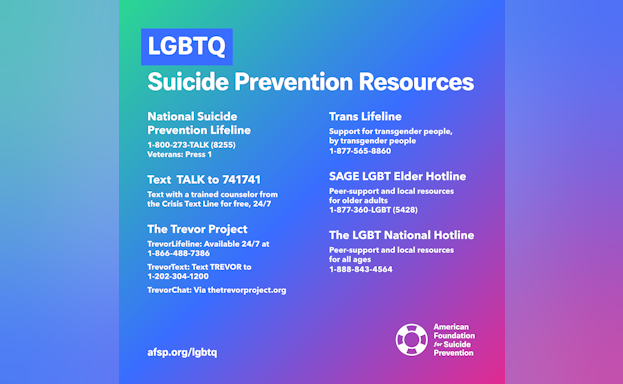
LGBTQ crisis hotlines and support resources.
Learn more
What can I exercise to protect my teen or tween from suicide risk?
As a parent, you can teach and model healthy habits for mental health only equally yous would with physical wellness. Taking care of your own mental health, talking about it openly, and seeking therapy when warranted is one way to model healthy practices.
If your child sees you approaching your ain challenges and learning for your own mistakes in an open fashion, they will empathize that information technology's okay to struggle and to acquire from mistakes. They may develop flexibility and compassion for their own missteps — possibly even empathy for others, seeing how you lot navigate challenging times. They volition too understand that life is messy and challenging for everyone at dissimilar times.
Cheque in with your child regularly, beyond but day-to-mean solar day tasks such as homework. You can acquire how to invite deeper conversations through further guidance listed on this page.
If your child has a history of depression, feet, suicidal thoughts, self-harm or substance use, you should monitor them more closely, and consider involving a professional, either at key times, or for the longer term for more chronic conditions.
How tin I tell if my child is behaving similar a normal teenager – i.e. moody, etc. – or if there might be something wrong?
When children hit puberty, at that place are changes in their body and brain that can and do atomic number 82 to behavioral changes. Just there is a normal range which can manifest as moodiness, irritability, and pushing y'all away. This is a natural office of adolescent development. What should be apropos is if you notice indications of hopelessness or worthlessness, a withdrawal from friends and activities, or suicidal thinking or behavior. These are not typical manifestations for teenage malaise.
Yous know your child. Yous know their usual patterns, their common reactions to frustration and challenges, and what their good days and bad days expect like. Trust your instincts if their behavior goes beyond these usual patterns of behavior. It could be just the tip of the iceberg of possible changes in their physical or mental health. It's worth engaging them in conversation to get a fuller understanding of what they are experiencing and so you lot can provide support, and go a meliorate sense of how severe information technology is.
If your teen or tween's slumber, energy, appetite, motivation, substance apply, and frustration aren't bouncing back to normal afterwards a few days, have them see their pediatrician or a mental health practitioner.
How can I talk to my teen about mental wellness and suicide?
Don't be afraid to have a conversation with your child about mental health and suicide. Ask your child how they're doing, what's happening in their earth these days, and what their concerns are. Information technology can beginning only by request, "Are you lot okay?"
Listen intently and without judgment. Ask open-ended questions, i.e. those that cannot be answered with a elementary yes or no. Resist the urge to offer quick fixes or solutions to their challenges, which tends to close down further dialog. Validate and back up their feelings.
Follow their cues, and say things like, "Tell me more about that. I'd honey to understand more about what that's like for you. When he said that/did that to you, how did that make you feel?"
Should I utilise the aforementioned approach for different age groups, i.due east. tweens (ages 8 to 12) or teens (thirteen to 17)?
The arroyo is very similar for tweens and teens, but with changes in language based on their level of sophistication and cocky-sensation. Use language that makes sense to your child, given their age, development, and what you lot know of how they recall near things.
For a young kid, y'all can ask about physical symptoms similar stomach aches, and changes in feelings like getting upset or angry more lately. If it seems to you that they experience hopeless, trapped or overwhelmed – and so ask if they always call back about hurting themselves or ending their life.
For older children, or kids who have demonstrated they are aware of their own thoughts and feelings, ask about their perceptions, also as other symptoms similar slumber problems, mood changes, and feelings of hopelessness, or of feeling trapped or overwhelmed.
What if they don't want to talk?
If your child isn't gear up to talk, exit the invitation open for later by saying, "Whenever you want to talk, I'm here to mind and support you lot." You could add together "I won't estimate, and I'll never finish supporting y'all, no matter what challenges yous face."
The likelihood is that your child will open up when you least expect information technology, sitting side-past-side rather than face-to-face, in the car or engaged in some other activeness together.
When your teen starts to open upwards, be conscientious not to autumn into the trap of jumping in with a solution or by saying, "You should…" or "Why didn't you…"
What if I'm concerned my child is thinking about suicide?
If your kid is talking about any level of distress, do not hesitate to ask them whether they're feeling changes in their mood or level of stress, or having suicidal thoughts. Asking your child directly about suicide will not increment their risk, or plant the idea. It will create an opportunity to offer support, and permit them know you care enough to take the chat.
You can say, "It sounds like you've been dealing with a lot lately. Does it ever get then tough that you think about ending your life?"
If your child gives any indication they accept been thinking about suicide (unless they are in the human activity of cocky-harming) take them seriously. Continue to listen and engage in a caring, concerned, supportive manner. You tin say things like, "Tin can you say more well-nigh that? I'thou so sorry you lot've been feeling this fashion. I want to understand more near your perspective. I'm hither for you no matter what. There is no problem also big that nosotros as a family unit can't go through. I'k going to go along supporting you and will also brand sure you lot get the help you lot need to experience yourself once more."
Talk with your child about how to seek assist. If yous fright they may exist at risk, go professional help right away.
Allow them know you'll be there for them no matter what, that your love is unconditional, and that you'll assistance them get the support they need to become through this challenging fourth dimension.
In a crisis situation, call the National Suicide Prevention Lifeline at 1-800-273-TALK or text the Crisis Text Line past texting 'TALK' to 741741 to speak or text with a trained counselor who can provide guidance on the most appropriate next steps and resources. Calling 911 is best for situations when cocky-harm is occurring or is well-nigh to occur.
For assist finding a Mental Health Professional, consult with your child's pediatrician, phone call your insurance, or use this treatment finder.
What if my child knows someone who has taken their life? How do talk with them?
It is important as a parent to be there for your child if a friend or a classmate has died past suicide. You can find specific guidance in AFSP's Children, Teens, and Suicide Loss booklet, written in partnership with the Dougy Center, The National Centre for Grieving Children & Families.
The booklet can be viewed online hither.
Source: https://afsp.org/teens-and-suicide-what-parents-should-know/
0 Response to "what can i do if my teen is threatening to kill himself or others"
Post a Comment