Cathedral of Saint James Santiago De Compostela Art History
What is Santiago Cathedral?
Located in the Galician municipality of Santiago de Compostela, in the north-east of Kingdom of spain, Santiago Cathedral is a Cosmic temple designed in the Middle Ages to hold the remains of Santiago (James) the Apostle, one of Jesus Christ'southward closest disciples.
Attributable to its long drawn out history, the cathedral, one of the most important centres of pilgrimage in the world, combines elements typical of Romanesque art such as demonstrated in the Glory Portico, with Renaissance and Baroque details, which tin be found on the hit Obradoiro Façade and the censer (the "Botafumeiro"), one of the most popular symbols of Santiago Cathedral.
The history of Santiago Cathedral
In the 8th century, nearly of the Iberian Peninsula was nether Muslim rule, which, past ways of conquests and treaties with Visigoth leaders, had woven a web of influence that went across the Pyrenees. Christian pockets of resistance to the invader were concentrated in the north of Spain, where the Kingdom of Asturias led a land annexation process that allowed information technology to extend its borders to the east and west.
Moreover, organized religion gave a symbolic significant to the reconquest policy of the Asturian monarchs, who contributed to the development of an episcopal network. In the ninth century, from the bishopric of Iria Flavia (close to present solar day Santiago) came the news of the discovery of a mausoleum that held the remains of James the Greater, ane of Jesus Christ's apostles. A church building was built to protect his relics, quickly replaced past a larger i that was able to respond to the early pilgrimages and underpin the cohesion of the territory.
However, the increasing enthusiasm for the Jacobean cult meant the design of the temple had to correspond with the importance of the relics, and by the year 1075 construction work began on Santiago Cathedral, an building that was inseparable from its surrounding urban construction and the infrastructures that connected the Iberian Peninsula with the rest of Europe.
The Obradoiro Façade
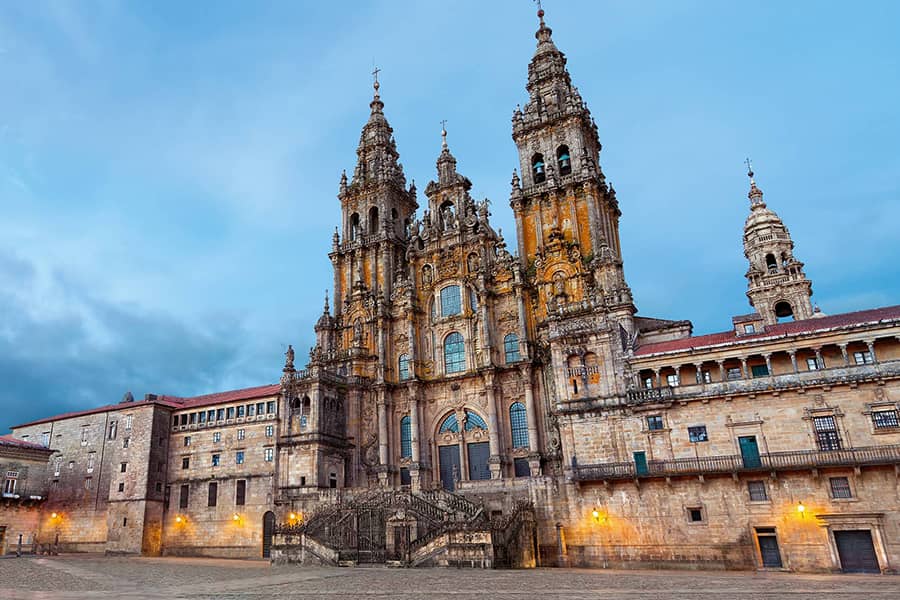
The Santiago Cathedral's western façade is a Baroque masterpiece which takes its proper noun from the big adjacent square which is where the temple's stonemasons' workshops were located. Its architect, Fernando de Casas Novoa, embarked on the construction of a new façade in the year 1738 attributable to the poor country that the Celebrity Portico was in.
The intervention on the façade of Santiago Cathedral was comprised of a pyramidal key body with big windows that joined up with the two existing towers in order to create a symmetrical whole. Moreover, by using detailed ornamentation, Casas Novoa underlined the vertical nature of his work, which was assisted past the Corinthian columns and the progressive narrowing of both the cardinal department and towers of Santiago de Compostela's cathedral.

The Platerías Façade
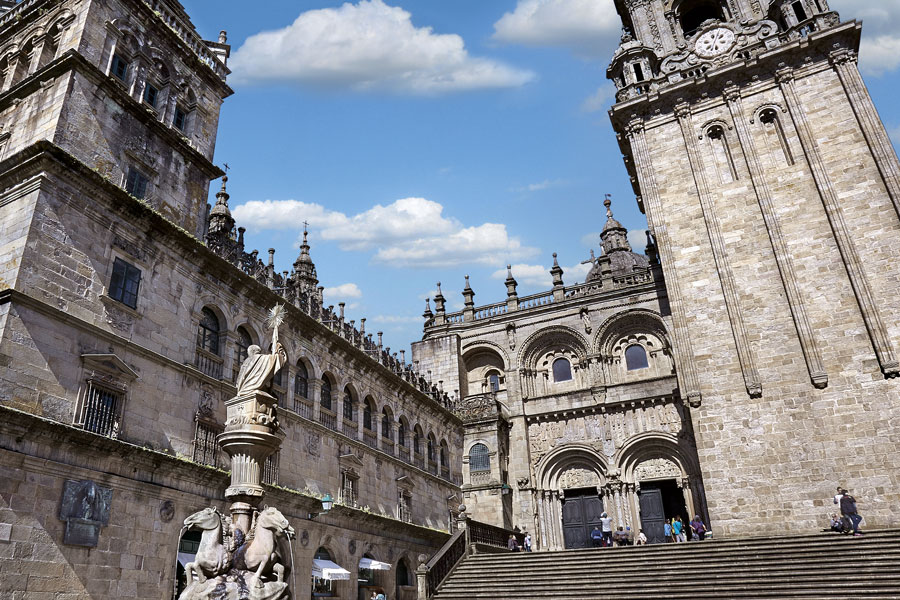
The Platerías Façade, which is named later the silversmiths that worked in the square, is the but façade of medieval origin that the Cathedral of Santiago de Compostela preserves, though diverse interventions in its decoration altered its original appearance. The façade was built between the years 1103 and 1117 as role of the construction plan outlined by Archbishop Diego Gelmírez, who had his palace on the southern side of the cathedral.
Thus, the front end acted as a nexus with episcopal ability, likewise being the space in which city hall trials were held. The ensemble is structured effectually a trumpet-shaped double door with semicircular arches and an upper frieze, which, just similar the tympanums, is profusely busy, while the two windows with lobed arches preside over the second level of the cathedral'south façade.
The Clocktower
Located at the intersection of the squares called Platerías and Quintana, the Clocktower was one of the get-go elements that altered the homogeneity of the Santiago Cathedral. The evolution of neighbouring districts on the south side of the temple led to the erection of a tower in the fifteenth century which, apart from highlighting the temple's presence in the town, was spacious enough to house a bell given equally a souvenir by French King Louis 11.
Between 1676 and 1680 architect Domingo de Andrade refurbished the belfry, and continued the medieval structure with a profusely decorated arcade, of squared base which in turn connects with an octagonal prism that the dome rests on forth with the lantern that is lit during the Holy Years.
The Quintana Façade
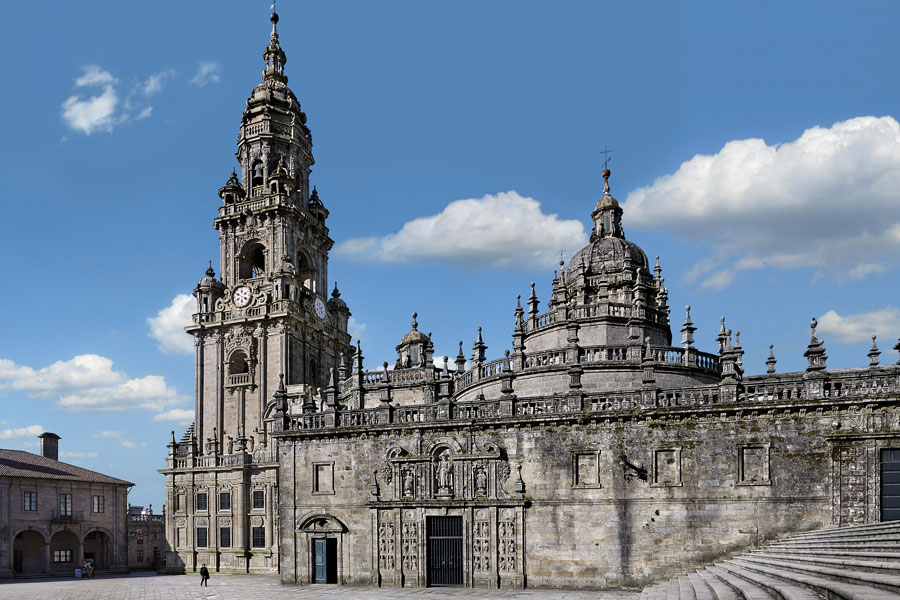
In lodge to hibernate the apsidioles that provided an uneven appearance to the medieval cathedral's chevet, in the seventeenth century Canon José Vega y Verdugo instigated the structure of a uniform enclosure. Thus, in 1658, architect José Peña de Toro set about working on closing the temple in a uniform way, building stone walls that form the façade and he included the cimborrio that was erected on meridian of the dome.
After Domingo de Andrade completed the refurbishment, the end upshot was a Baroque ensemble that was organised into 2 separate canvases (on which the Regal Door and the Holy Door stood out) that formed a big anteroom for visitors to the Santiago Cathedral.
The Azabachería Façade
Initially known as the Door of Paradise, the n façade was always the busiest, as it marked the end of the French pilgrimage route. Nevertheless, in 1758 the canonry decided to demolish the Romanesque façade and entrusted builder Lucas Ferro Caaveiro with the new ane, who drew from the Baroque manner and who was soon substituted past Domingo Lois Monteagudo, chosen past the Academy of Fine Arts in order to introduce neo-Classical resources into the design.
Divided into three floors, the resultant façade –known every bit the Azabachería, due to the presence of craftsmen in the square that worked with jet or lignite (a mineraloid chosen azabache in Spanish)– was peculiarly hit for its Greco-Roman character, underlined by the Doric columns on the lower flooring and the presence of rosettes and decorative medallions.
The Glory Portico
On the 23rd of February, 1168, Male monarch Ferdinand Two of León made it known that Master Mateo –of unknown origin– would receive a lifelong wage in order to consummate the western side of the Cathedral of Santiago de Compostela. The privilege earned by the architect corresponded with the complexity of the project, since the sloping terrain meant he would have to devise a solution that was based around 3 singled-out levels.
In club to go over the unevenness, a crypt was planned, a structure that was unprecedented in Galician architecture at the time and which the Celebrity Portico is built upon, consisting of three flared arches (ane for each of the cathedral's naves) decorated with allegorical sculptures. Lastly, on the upper level, the gallery extension was completed and a vault was added which meant the plans for the crypt and façade could finally come to fruition.
Inside Santiago Cathedral
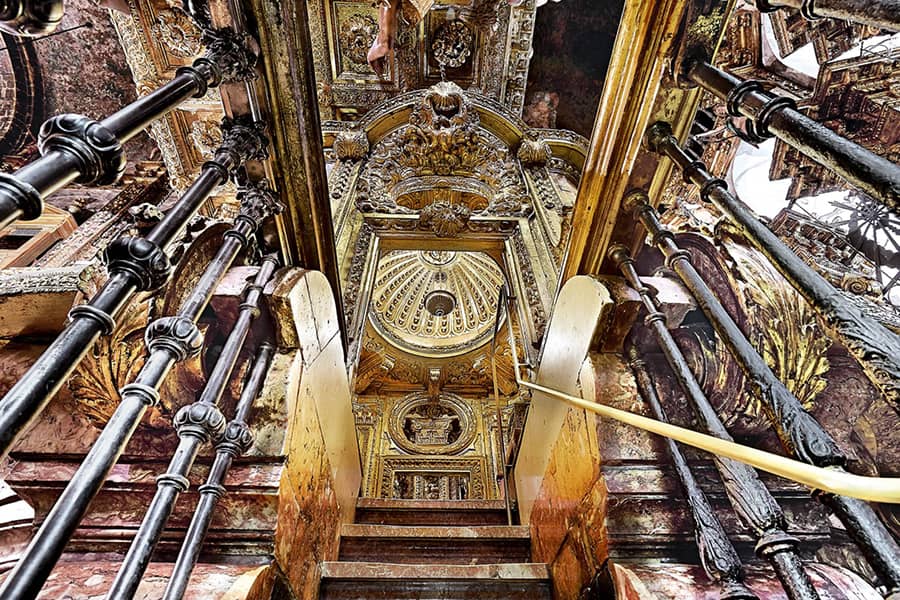
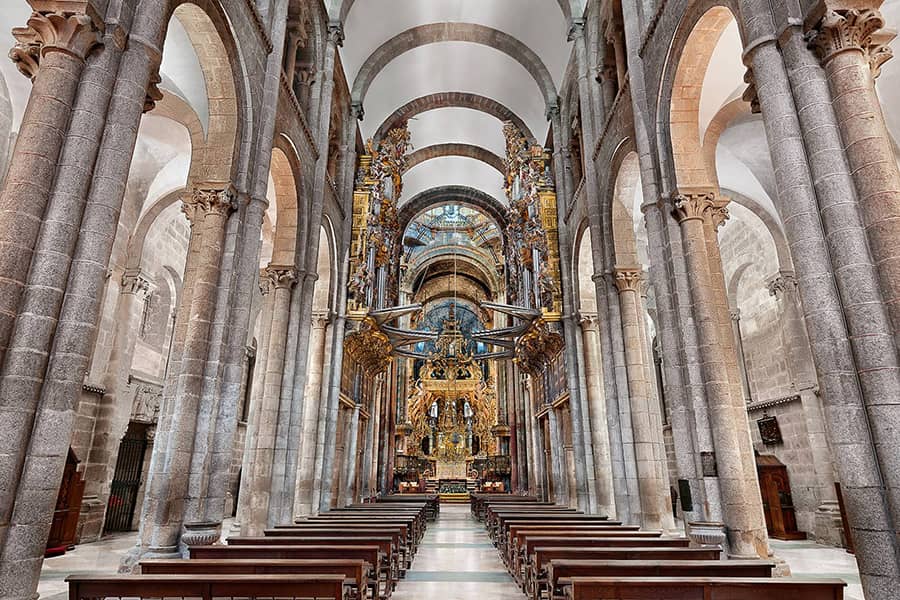
Planned as the largest Romanesque temple on the Iberian Peninsula, Santiago Cathedral is organised effectually a Latin cross ground plan scheme with two crossing artillery. The first one, 97 metres long, goes from west to east and directs the worshippers' gaze to the chevet –with reference to the path from the earthly to the divine–; while the other goes from north to south.
On the two-armed intersection –each i of them divided into 3 naves– is the high altar, surrounded by an convalescent. With this construction, Santiago Cathedral could bargain with numerous pilgrims and, at the aforementioned time, create a space appropriate for worship.
The cathedral cloister
Started in 1521 by order of Archbishop Alonso 3 of Vilaseca, the construction of Santiago Cathedral's cloister –designed over a gallery damaged in the 15th century by a series of pop uprisings– savage upon architect Juan de Álava, in order to after laissez passer through the hands of Rodrigo Gil de Hontañón, Juan de Herrera and Gaspar de Arce.
Despite this shared authorship, the expanse conserves slap-up unity in its 4 wings, structured around broad arcades and covered with starred vaults that blend in with the medieval origin of the building.
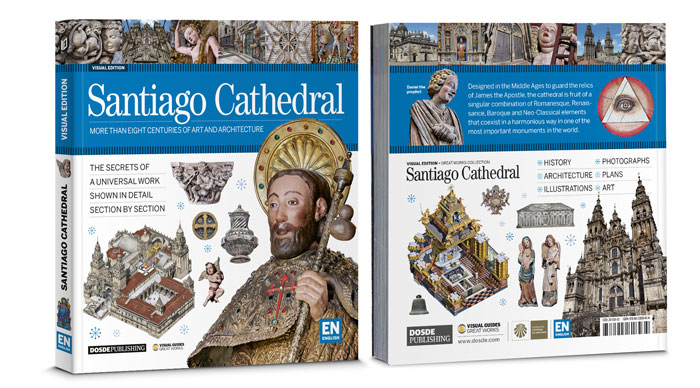
A volume to discover all the nooks and crannies of the Cathedral of Santiago de Compostela
Built to concord the remains of James the Apostle, the Cathedral of Santiago de Compostela is i of the globe'south major pilgrimage sites.
With more than 300 pictures and 3D illustrations this book is one of the most consummate books published on the Cathedral of Santiago de Compostela. Information technology provides a unique insight into its origins and architecture. An essential book to find out everything near the cathedral.
Source: https://www.dosde.com/discover/en/santiago-cathedral/
0 Response to "Cathedral of Saint James Santiago De Compostela Art History"
Post a Comment