Is Mauna Loa Active Is There Plan for to Erupted Again Mauna Loa
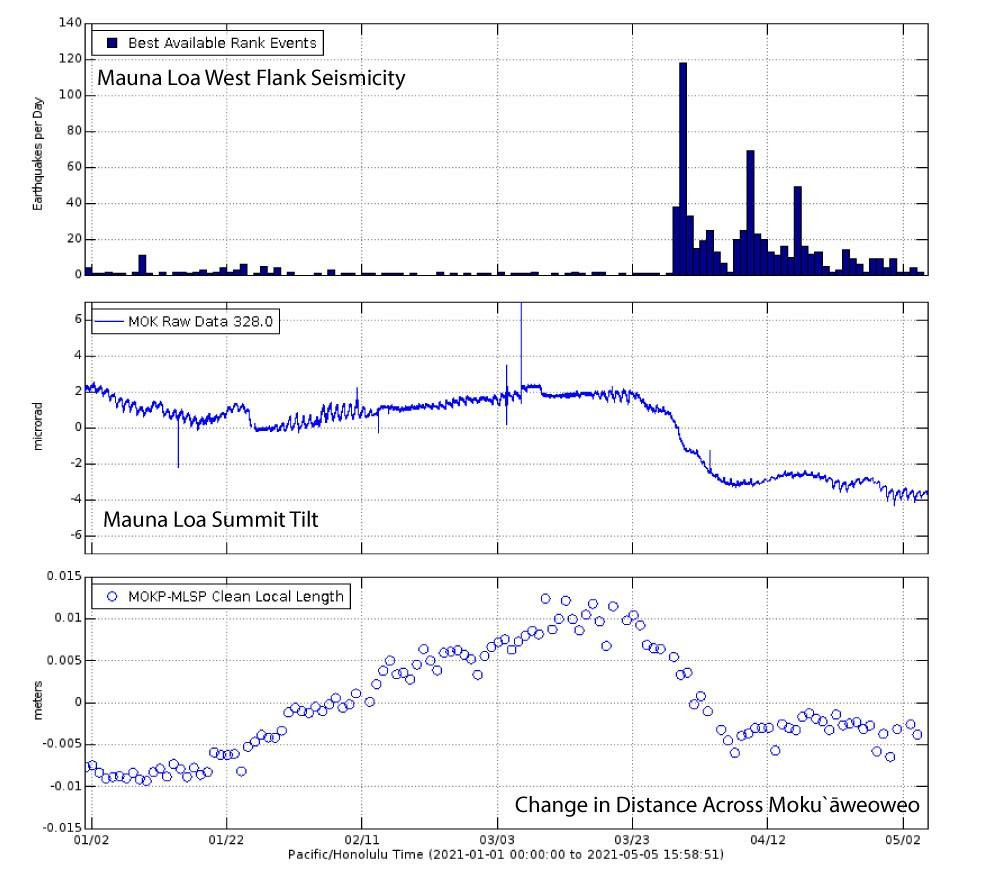
USGS: Data plots showing some of the features mentioned in this week'due south "Volcano Watch" commodity. The top panel is a histogram of seismicity on Mauna Loa's west flank, showing an increase in activity in that region over the past calendar month. The eye console is a tilt record from a tiltmeter near Mokuʻāweoweo, the change in tendency from March 23 to April 5 is the start fourth dimension a tilt alter at Mauna Loa could be ascribed to volcanic changes. The bottom console testify the modify in distance across the tiptop caldera, equally measured by GPS. Lengthening of the line indicate expansion of the volcano, and decreases indicate wrinkle. USGS plots.
(BIVN) – Mauna Loa is not erupting, and scientists on Th reported depression rates of deformation at the summit of the behemothic volcano over the by week.
This week's Volcano Picket article, written by Hawaiian Volcano Observatory research geophysicist Ingrid Johanson, examines the tiny changes observed at the top of Mauna Loa in recent months. Johanson writes:
Although Mauna Loa is Earth's largest active volcano, it has lived in the shadow of Kīlauea since it last erupted in 1984. The geologic record shows that Mauna Loa erupts every seven years on average; withal, 37 years accept passed since lava flows from the volcano's Northeast Rift Zone came within 7 km (iv miles) of Hilo.
Nonetheless, Mauna Loa volition certainly erupt again anytime and extensive monitoring efforts of the USGS Hawaiian Volcano Observatory (HVO) accept continued throughout the decades.
Recent changes in deformation and seismicity on Mauna Loa are the latest in a series of "rumblings" that arguably began in 2004. At that fourth dimension, Global Positioning System (GPS) instruments showed inflation of the volcano'southward elevation reservoir system accompanied past vey deep earthquakes. This behavior continued for several months before Mauna Loa returned to its groundwork state. Summit inflation began again in 2014, this time together with shallow earthquakes, and has continued ever since, with only a short interruption in 2018.
In the past six months, there has been an uptick in earthquake activity on Mauna Loa's west flank and changes in the pattern of deformation at its height. These changes are minor, sometimes barely higher up the noise, but may be telling usa that the magma system is evolving in important ways.
Technology has changed a lot in the 37 years since Mauna Loa'due south concluding eruption.
Today, HVO monitors Mauna Loa deformation using over xxx GPS stations, vii tiltmeters, and regularly analyzed satellite radar data. The higher rate of sampling and greater sensitivity of the instruments gives us the means to encounter much more than detail. As nosotros continue monitoring Mauna Loaʻs unrest, we too hope to learn much more near how the volcano behaves and look for clues to the next eruption.
Three observations from the past several months are especially interesting (to a geophysicist).
The outset is that the direction of deformation at Mauna Loa's acme has had reversed twice since October 2020, switching back and forth from an outward (expansive) management to an inward (contractional) 1. The most recent contractional episode shortened the altitude beyond Mauna Loa'south superlative caldera (Mokuʻāweoweo) by only almost 1.v cm (0.6 inches). This is small-scale compared to amount of expansion that has taken place, but the sudden reversal is new behavior that hasn't been observed at Mauna Loa with modern instruments.
The second observation was the occurrence of a small, shallow magnitude-3.2 earthquake in Mokuʻāweoweo on March 6. Using satellite radar, we were able to see that the convulsion caused nigh x cm (4 inches) of subsidence in a pocket-size portion of the caldera. This is very unusual for a magnitude-3.2 convulsion and indicates that the error may have slipped all the way up to the ground surface.
The 3rd observation is the smallest but may be the most meaningful. Outset on March 23, a tiltmeter near Mauna Loa's summit recorded a alter in tilt of about 5 microradians. It is not unusual to come across this much tilt at Kīlauea, simply there has never before been a tilt signal that could be attributed to changes in Mauna Loa'south volcanic organisation. Changes in tilt at Mauna Loa accept been observed due to daily or seasonal temperature changes and considering of rainfall, but never before due to volcanic deformation.
These new observations are interesting considering they advise some of the deformation is driven past shallower processes than we have seen in the past several years. Considering this is the beginning fourth dimension we've observed this level of item, it is difficult to know what the information might indicate about the volcano'southward future. Mauna Loa may become serenity over again and render to background, like it did in 2005, or it may not.
Mauna Loa is currently at "informational", just the second out of 4 levels in the USGS Volcano Alert-Level System. We expect that there volition be additional indicators, such as increased gas emissions and a sustained increase in seismicity, before any hereafter eruption. These recent observations remind u.s. that Mauna Loa is a restless volcano and they are part of why HVO encourages anybody to recollect about how a Mauna Loa eruption might affect them and plan accordingly.
Mauna Loa remains at Volcano Alarm Level ADVISORY. The USGS Hawaiian Volcano Observatory says this alarm level does not mean that an eruption is imminent or that progression to an eruption from the current level of unrest is sure.
Source: https://www.bigislandvideonews.com/2021/05/08/volcano-watch-scientists-track-mauna-loa-summit-changes/
0 Response to "Is Mauna Loa Active Is There Plan for to Erupted Again Mauna Loa"
Post a Comment